Adaptive Reuse of Heritage Structures: A Technical Framework
A technical overview of the spatial documentation, structural assessment, and services integration challenges in converting heritage buildings.
Turning an old building into something new without destroying what makes it special is difficult. The gap between how a heritage structure was originally built and what a modern use requires can be massive. To close that gap, you need to know exactly what is there right now, not what was on the original drawings.
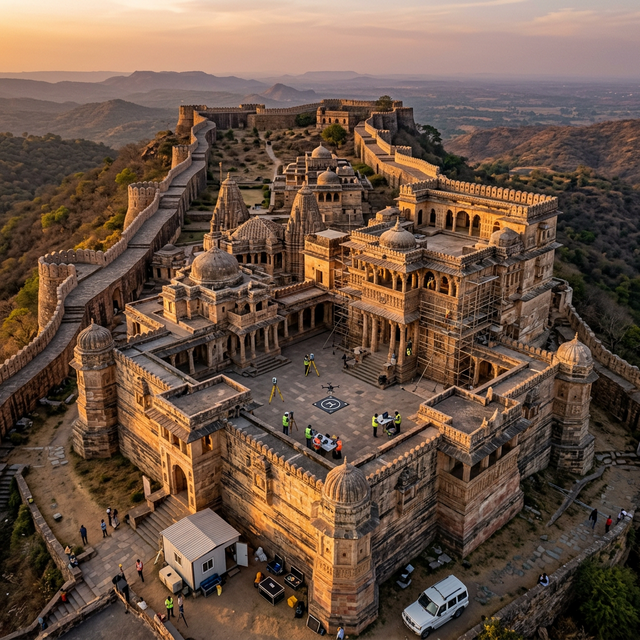
Why keep the old buildings?
The math on adaptive reuse is changing. Tearing down and rebuilding costs a lot of embodied carbon, and regulators and investors are finally starting to care. Plus, old colonial civic buildings, industrial complexes, and institutional buildings offer space and materials you simply cannot afford to build from scratch today.
India has a lot of these underused government buildings: railway heritage sites, cantonment bungalows, court complexes. The problem usually isn't political will. It's technical capacity. We have to figure out what the building can hold, where to run pipes and wires without wrecking historic fabric, and how to prove it to the regulators.
The core problem: We don't know what's there
Most historic Indian buildings were built without engineering drawings. Even if drawings existed, they were done in imperial measurements and are probably lost. And over decades of continuous use, people make changes—some official, many not. The building standing in front of you rarely matches the paperwork.
This creates a massive headache for the design team. Structural engineers can't assess a building they can't accurately measure. Services engineers can't route HVAC through walls when they don't know what's inside them. If you want adaptive reuse to work smoothly, the very first step is getting a precise geometric record of the actual structure.
Documenting the space
Terrestrial LiDAR Survey High-density 3D laser scanners capture every surface—walls, ceilings, floors, columns, arches, and ornamental details—down to the millimeter. This point cloud becomes the baseline for every engineering decision that follows. Unlike tape measurements, you can measure anything in the point cloud without making another trip to the site.
Photogrammetry While LiDAR gets the geometry, cameras get the texture and color. For interiors with carved stone or painted surfaces, a textured 3D mesh gives conservation engineers the visual detail they need to assess the condition without touching the fabric.
Heritage BIM (HBIM) We build a Heritage BIM model from the survey data. It's not just geometry; we encode construction history, material layers, and known damage. Unlike a standard BIM model for a new building, an HBIM has to handle the messiness of hand-built history: irregular arches, walls that lean out of plumb, and floors that slope.
Condition Mapping Conservation architects and engineers annotate the HBIM to show where the damage is—cracks, moisture zones, spalled masonry. This layer tells the team what needs repair and what areas can actually take the new structural loads.
Structural assessment
Most historic Indian buildings are load-bearing masonry—brick or stone with lime mortar, and often timber floors. Because these materials behave very differently from modern concrete, you have to be careful when adding new loads.
- Masonry Testing: Core samples and in-situ tests tell us how strong the masonry is. We also analyze the mortar because lime mortar behaves entirely differently from cement under load. Ground-penetrating radar lets us map wall thickness and find voids without knocking holes in the wall.
- Foundation Checks: The original stone rubble foundations were designed for the original use. If you're turning an old warehouse into apartments, the live loads change dramatically. That usually means assessing the foundation capacity and often underpinning or piling.
- Monitoring: During construction, we use tiltmeters, crack gauges, and settlement plates to watch how the building reacts to the work. If it moves, we stop and review the methodology. It's a level of paranoia you don't need on new builds, but it's mandatory here.
- Floor Loads: Existing timber joists or stone flags need to be checked. If they aren't strong enough, we look at sister joisting or structural topping slabs. Sometimes we completely replace the floor using a new, reversible system that won't damage the historic walls.
Adding modern services
Putting modern electrical, HVAC, and plumbing into a historic structure is usually the hardest part of the design. Regulations typically stop you from cutting chases into historic stone walls, drilling through decorations, or running ugly surface conduits.
- Keep it Reversible: Every new service should be removable without damaging the historic fabric. That means prioritizing raised access floors, suspended ceilings (if appropriate), and running pipes through new, non-historic partition walls.
- BIM Clash Detection: We use the HBIM model to coordinate all the MEP services before anyone touches the site. Finding out a duct hits a historic arch is much cheaper on a screen than it is on site.
- Thermal Mass: Historic masonry buildings manage heat differently than thin modern walls. If you blast a thick masonry wall with modern air conditioning, differential thermal expansion can destroy historic lime plaster. The environmental systems need to work with the building's thermal mass, not fight it.
The paperwork
Adaptive reuse involving protected heritage requires approvals from the Archaeological Survey of India (ASI) or state departments, plus local body change-of-use permissions. They all want accurate measured drawings.
When correctly built, the HBIM model acts as the single source of truth for all these submissions. When the conservation statement, the structural design, and the architectural drawings all come from the same verified 3D baseline, you avoid the contradictions that typically cause regulatory delays.
Life after the project
The HBIM model's job isn't done when construction ends. It becomes the facility management tool. Maintenance records get tied to the specific 3D elements. Condition surveys are loaded as new data layers. The building's entire conservation history lives in one queryable place. This is crucial for heritage structures—the next time someone works on the building fifty years from now, they will actually know what was done today.