How Digital Twins Are Transforming Indian Highway Management
How federated BIM and GIS platforms are changing the way highway authorities plan, monitor, and maintain large-scale infrastructure assets.
India has the second-largest highway network in the world. Historically, it's been managed with paper records, spreadsheets, and engineers driving around looking for potholes. Digital twins are finally offering a better way to track all that asphalt.
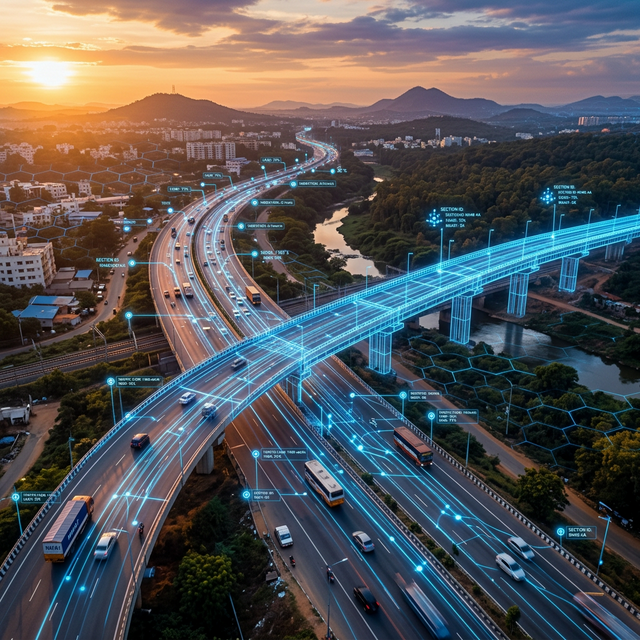
The scale of the problem
India manages over 145,000 km of national highways and millions of kilometers of state and rural roads. If you're a highway authority or a concessionaire, you have a massive data problem: how do you track the condition of thousands of bridges, hundreds of tunnels, and endless stretches of pavement without going bankrupt?
The old way—sending crews out for annual or biennial inspections—leaves massive blind spots. A pothole that forms right after inspection season might not get documented until it breaks an axle and causes a traffic jam. Reactive maintenance like this ends up costing authorities far more than just fixing things early.
What a highway digital twin actually is
A digital twin isn't just a fancy 3D visualization. It's a spatial database that ties a bunch of different data streams into one model you can actually query.
- Geometry: We use survey-grade LiDAR and photogrammetry to map the road, the slopes, the drains, and the roadside assets down to the millimeter.
- Pavement condition: Mobile mapping and AI defect detection give us a continuous scan of the pavement surface.
- Structural health: For major bridges, we tie live data from vibration sensors, strain gauges, and tilt monitors directly into the twin.
- Traffic data: Live axle load sensors and traffic counters tell us exactly how much punishment the road is taking, which helps predict when the pavement will actually fail.
- Maintenance history: Every time a crew fixes something, it gets logged against the spatial twin. You build a permanent history of what went wrong and where.
What this looks like on the ground
When we start a digital twin project for a 300 to 400 km highway corridor, the first step is driving the whole thing with a mobile LiDAR rig. The AI processes the data and usually flags a significant number of pavement defects that the authority’s existing database missed completely. We tie the whole model to the national GNSS control network, and suddenly the authority has a single source of truth.
The impact is usually immediate. Authorities consistently tell us they see a drop in emergency repair budgets within the first year because they catch pavement distress before it gets expensive. You stop guessing where to spend the budget and start directing it to the highest-risk segments.
It's not just about maintenance
The twin changes how oversight works, too. Independent engineers monitoring concessionaires don't have to spend as much time driving the route. They can review AI-flagged condition changes directly in the spatial record every quarter.
It also helps with liability. When there's a third-party accident claim involving a supposedly bad road, having a timestamped, geo-referenced condition record resolves the dispute much faster than digging through paper inspection logs.
The roadblock
The technology for digital twins is already here. The sensors, the processing algorithms, and the delivery platforms are mature. The actual barrier is institutional inertia. Procurement frameworks and data ownership policies move slower than technology. But the authorities who are setting up their spatial baselines today are going to have a massive advantage over the ones who wait, simply because they'll actually know what they own.