Heritage Demolition Is a Failure of Engineering Imagination
Tearing down heritage isn't just cultural erasure — it's a failure of engineering imagination. Data proves adaptive reuse saves far more carbon than demolition.
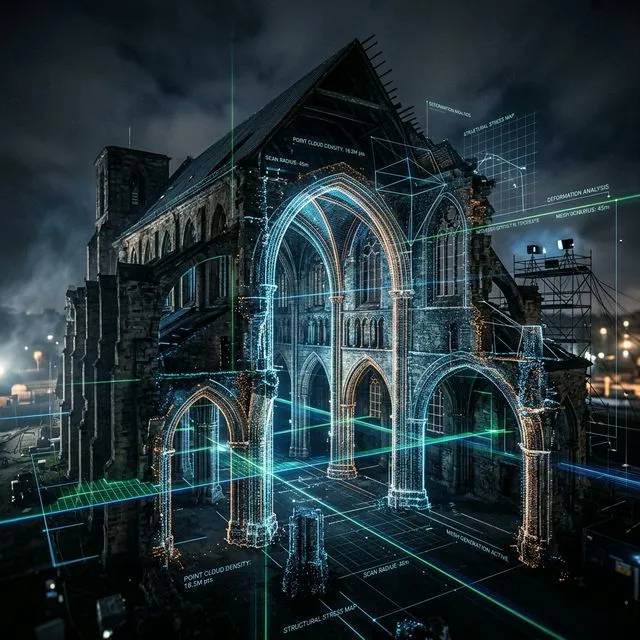
As seen in the laser scanning imagery above, we now have the technological capability to understand and interact with historic structures like never before.
We map their every flaw and detail with millimeter precision. We can virtually peel back layers of stone, brick, and timber to understand exactly how a building breathes and distributes its weight. Yet, despite this incredible technological leap, our default response to an aging building remains stubbornly primitive: bring in the wrecking ball.
Pritzker prize-winning architect Anne Lacaton famously stated, "Demolishing is a decision of easiness and short-term. It is a waste of many things, a waste of energy, a waste of material and a waste of history. For us, it is an act of violence."
For decades, the real estate and development industries have sold us a comfortable myth. We have been told that tearing down old, inefficient buildings to make way for shiny, ultra-modern "green" new builds is the ultimate path to progress. But when you actually crunch the numbers, the data tells a vastly different story. Tearing down our architectural heritage isn't just an erasure of our cultural memory. It is a massive failure of engineering imagination.
Here is why reimagining existing Indian structures isn't just a romantic ideal, but the only true way forward.
The Climate Cost of the Wrecking Ball
It is a remarkably common misconception that erecting a highly energy-efficient new building will quickly offset the emissions produced during its construction. In reality, it takes anywhere between 10 to 80 years for a new "green" building to simply overcome the immense negative climate impacts created by building it in the first place.
The embodied carbon, meaning the staggering volume of emissions resulting from extracting, manufacturing, and transporting new construction materials, is the elephant in the room. For instance, the demolition of a sprawling historic textile mill complex in Mumbai releases tens of thousands of tonnes of CO2 into the atmosphere. That single act effectively undoes decades of civic carbon-saving efforts.
By contrast, working with what we already have yields massive, immediate environmental dividends. A recent Life Cycle Assessment of a colonial-era civic building in Kolkata proved that adaptive reuse actively avoided over 80% of the global warming potential compared to knocking it down and starting from scratch.
The Economics of Imagination
There's a persistent, lazy excuse for demolition: working around old structural quirks is simply too expensive.
The numbers completely disagree. On average, the cost of a large commercial rehabilitation is actually about 4% lower than comparable new construction on a cleared site.
And when real engineering imagination is applied, those savings absolutely skyrocket. Take the recent adaptive reuse of the Alembic Industrial Heritage Development in Vadodara. By successfully preserving the structure's existing historic masonry and steel framework, the project yielded massive savings in embodied carbon for those materials. More impressively for the developers holding the purse strings, the overall project budget was significantly smaller than the cost of a new build, saving millions in capital expenditure.
Furthermore, heritage conservation is an incredible economic catalyst at a local level. Because rehabilitating an older building is highly labor-intensive rather than material-heavy, it actually creates far more specialized jobs per dollar invested than building new in India.
Engineering the Future of the Past

The perception that older structures are somehow inherently unsafe or unusable relies on a deeply outdated understanding of what is technically possible today. Modern structural conservation engineers have an arsenal of remarkably advanced tools at their disposal.
As the laser scanning visualization at the top of this article highlights, seamlessly integrating point cloud data into Heritage Building Information Modeling (HBIM) allows us to forensically assess an existing building in three dimensions. We can plan precise, surgical interventions rather than relying on heavy-handed demolition.
Today, engineers can use discreet, hyper-targeted solutions. Think stainless steel helical anchors, installed directly through mortar joints, to invisibly stabilize bulging walls and reconnect failing facades. Where century-old foundations need strengthening to handle new modern loads, high-pressure "jet grouting" can be dynamically injected into the soil to create solid structural piles all without destroying the historic fabric above ground.
When buildings age or structural systems begin to fail, it shouldn't be viewed as the tragic end of their lifespan, but rather as a generative moment for creative reinvention.
Saving the Urban Soul
Ultimately, the ethical implications of our demolition obsession go far beyond carbon footprints and budget spreadsheets. Erasing urban history is quite literally like tearing pages from a city's soul. Cities like Delhi, Kolkata, and Hyderabad are layered palimpsests of human experience. Each demolished block removes a physical, tangible link to our collective memory and cultural identity.
When we rely on demolition as the default, we invariably displace communities and erode the social fabric. But when we apply genuine engineering and architectural imagination, we preserve continuity. Visionary architects are proving that even densely inhabited century-old neighborhoods like the pols of Ahmedabad or historic chawls in Mumbai can be radically upgraded. They improve living conditions, sanitation, and structural integrity without displacing a single resident. Amazingly, this is often done for the exact same budget the local government had originally allocated just to demolish a single apartment block.
Heritage structures are not stubborn obstacles to progress, they are brilliant, open propositions. It takes vision, deep patience, and high-level technological savvy to see the vibrant potential hidden in aging brick and steel.
As our industry moves forward, we must abandon the wrecking ball and embrace a fundamental truth: the most sustainable building is almost always the one that already exists.