Designing Multi-Village Water Supply Schemes: A Step-by-Step Breakdown
The engineering reality behind massive rural water projects like the Jal Jeevan Mission—from finding the source water to submitting the final DPR.
The Jal Jeevan Mission promised tap water for every rural household in India. It's an incredible ambition, but actually engineering the pipes, pumps, and treatment plants for thousands of remote villages is a massive logistical and technical hurdle. Most people only see the tap—here is what happens before the water flows.
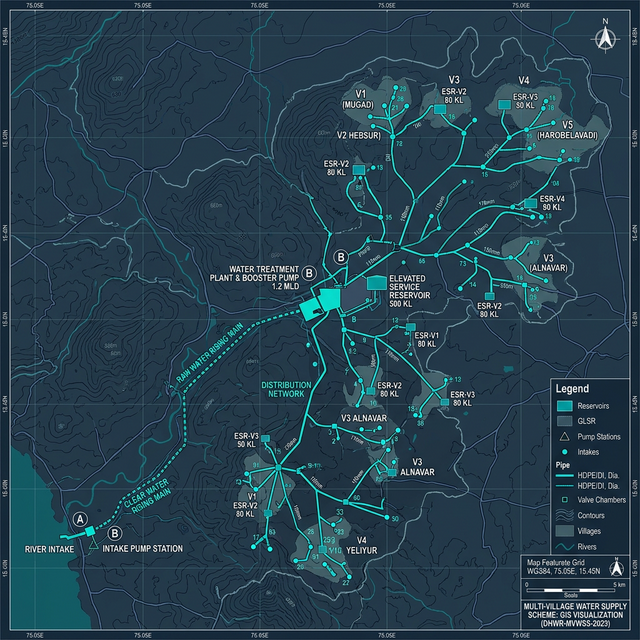
What is a multi-village scheme?
Instead of drilling a local borewell for every single village, a multi-village scheme connects anywhere from 10 to 100 villages to one reliable, shared water source.
The benefits are obvious: it's cheaper per household, the treatment plants run more efficiently, and river sources don't dry up like local borewells do in the summer. But the design challenge is brutal. You have to balance the hydraulics so that the last house in the highest village gets exactly the same water pressure as the first house next to the pump station, across hundreds of kilometers of pipe.
Step 1: Prove the source
We can't design anything until we prove there's actually enough water. Whether it's a river, a dam, or a massive borewell cluster, we have to look at the hydrology to prove it can handle the peak summer demand 30 years from now. We run pump tests, pull samples for the water quality labs (because you can't design the treatment plant until you know what's in the water), and start the long process of getting withdrawal permits from the state water resources department.
Step 2: Run the numbers
We don't guess how much water people need. We calculate the design demand based on standard codes (usually 40 to 70 liters per person per day for rural areas under IS 1172), add extra for schools and hospitals, buffer it by 15% for acceptable pipeline leaks, and project the population growth decades into the future using Census data.
Step 3: Balance the pipes
This is where the heavy engineering happens. We build a massive hydraulic model in EPANET or WaterGEMS. We map out the entire network from the river intake all the way to the village standposts.
The software helps us size the pipes correctly. If a pipe is too small, the friction kills the pressure and the water never reaches the end of the line. If a pipe is too big, the water moves too slowly and sentiment starts to build up, harboring bacteria. We divide the system into zones—trunk mains driving water to giant overhead tanks, and smaller distribution networks feeding the actual streets.
Step 4: Storing the water
You can't pump water 24/7—power grids in rural areas won't support it, and the pumps need maintenance. That means we have to design Elevated Service Reservoirs (ESRs) and ground-level tanks. We size them to hold enough "balancing storage" to handle the morning rush when everyone turns their taps on at once, plus emergency reserves in case the main pumps fail for a day.
Step 5: The pump stations
Gravity alone almost never works for these massive regional schemes. We have to design heavy-duty pump stations to push water uphill over long distances. We run lifecycle cost analyses on different pump configurations because buying a slightly cheaper pump today that burns 20% more electricity over the next decade is a terrible engineering decision. We also design the surge protection—massive air vessels that stop the pipes from exploding if the power cuts out and the water hammers backwards.
Step 6: The paperwork
The final deliverable is the Detailed Project Report (DPR). This is the master document the government uses to approve funding and hire the actual construction contractors. A good DPR has perfectly balanced hydraulic calculations, massive sets of engineering drawings, exact Bills of Quantities (so contractors know exactly how much pipe to buy), and the final estimated construction cost.
Where things usually go wrong
When we get called in to look at schemes that aren't working, we usually see the same mistakes. Engineers will use old population data without projecting growth, meaning the pipes are too small ten years after they are laid. Sometimes they try to save money by shrinking the overhead tanks, which means the whole system depressurizes the moment there's a power cut. The most successful projects are the ones where the designers didn't cut corners on the math in Step 3.
Need help reviewing or designing a major water scheme? Get in Touch →