Drones vs. LiDAR: Stop Arguing and Pick the Right Tool
A practical breakdown of when you should use photogrammetry and when you actually need to pay for LiDAR.
There's a persistent argument in the surveying world about whether drone photogrammetry or drone LiDAR is "better." It's a pointless argument. They are fundamentally different technologies solving different problems. Here is how we decide which one to fly.
Photogrammetry: Painting with pixels
Drone photogrammetry is essentially taking thousands of overlapping photos and using software to figure out the 3D geometry based on how the perspective shifts from photo to photo.
It is incredible technology. It's relatively cheap to mobilize, the sensors are light, and the final output is a beautiful, photorealistic 3D mesh. If you need to show stakeholders what a site looks like, or calculate earthwork volumes on a bare dirt construction site, photogrammetry is usually the right answer.
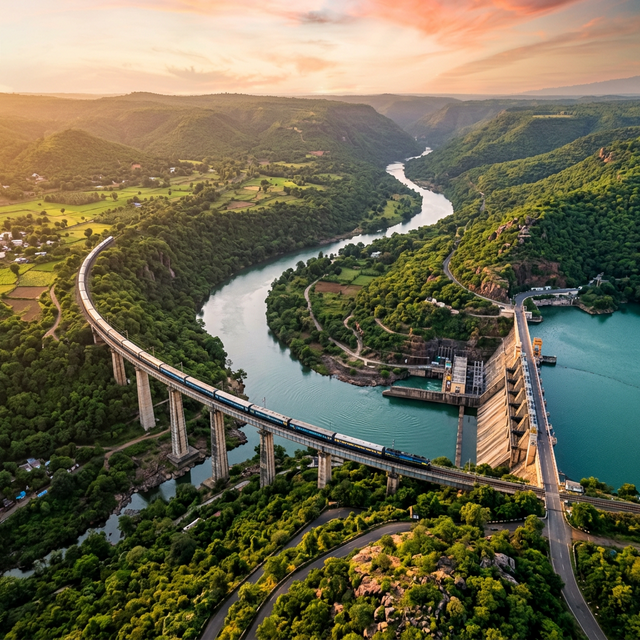
But it has a fatal flaw: it can only map what the camera can see. If you fly over a dense forest, photogrammetry will give you a beautiful 3D model of the treetops. It will give you absolutely zero data about the actual ground underneath.
LiDAR: Punching through the noise
LiDAR doesn't care about photos. It fires hundreds of thousands of active laser pulses every second and measures exactly how long they take to bounce back.
Crucially, LiDAR can record multiple bounces from a single pulse. If a laser fires into a tree canopy, some of the light hits top branches, some hits lower leaves, but a fraction of that light makes it all the way down to the dirt. That single pulse gives us both the canopy height and the true bare earth elevation.
If you are doing engineering design for a highway alignment through a forested valley, LiDAR is the only mathematical way to get the true ground terrain.
The realities of flying
We fly both systems constantly across India, and here is how the operational math usually breaks down:
- Accuracy: Good photogrammetry with massive ground control can hit ±50mm vertically. Good LiDAR tied to RTK GNSS can routinely hit ±30mm or better.
- The Underside Problem: Drones looking down can't see the underside of a bridge. A LiDAR sensor bouncing lasers off angled surfaces has a much better chance of capturing critical structural geometry that a camera misses entirely.
- Weather: Photogrammetry needs good light. It fails in heavy shadows, fails at dusk, and struggles in hazy conditions. LiDAR is an active sensor—it provides its own light. We can fly LiDAR at night or in heavy dust and still get perfect geometry.
- The Processing Nightmare: Photogrammetry takes furious computing power to stitch images together, but the software is highly automated. LiDAR requires a specialist to classify the points, filter the noise, and carefully assemble the strips.
Making the call
If you just want a visual update on how your construction site is progressing, pay for photogrammetry. It's cost-effective and looks great.
But if you are designing a massive gravity-fed water network across 100 kilometers of hilly, vegetated terrain, do not cheap out. Pay for the LiDAR. If your terrain model is wrong by half a meter because the camera couldn't see through the brush, your entire hydraulic design is compromised before you lay the first pipe.