Why Most 'Road Safety Audits' Are Just Inspections in Disguise
A Road Safety Audit is an independent, brutal teardown of a road design to find the flaws before the concrete dries. It is not a pothole checklist.
Road Safety Audits (RSAs) are completely misunderstood. Authorities constantly ask for an RSA when all they really want is someone to drive down the highway and count the broken streetlights. That's a maintenance inspection. An actual audit is much more rigorous, and occasionally much more uncomfortable for the design team.
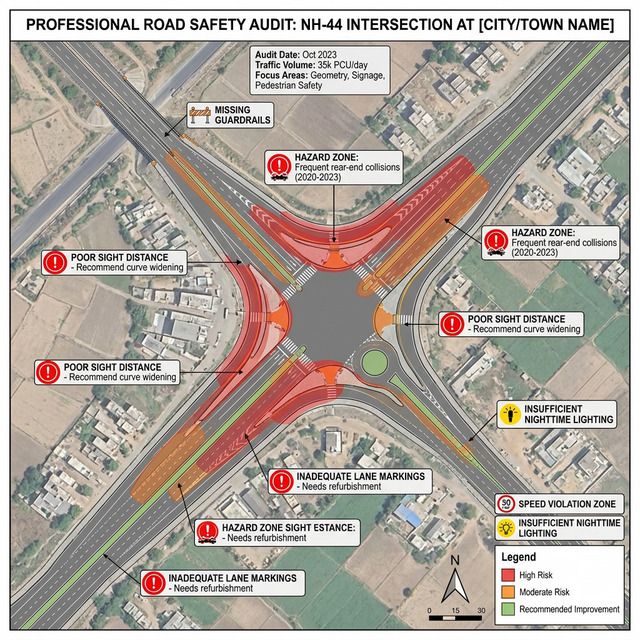
The difference that matters
An inspection looks at a road and asks, "What is broken?" It finds faded paint, missing signs, and potholes.
An audit looks at the fundamental geometry of the road and asks, "How is someone going to die here?" It looks for design choices that will confuse drivers, hide pedestrians, or invite catastrophic collisions, regardless of whether the asphalt is brand new.
More importantly, a true audit is strictly independent. You cannot audit your own design. A highway designer will always rationalize why they put a junction on a blind curve—"we couldn't buy the land," "the client pushed for it." An independent auditor doesn't care about the politics; they only care about the physics of the impending crash.
The four stages of catching a mistake
Under the IRC SP:88 standards, we conduct audits at four specific times. Catching a mistake early saves millions; catching it late saves lives.
Stage 1: The Feasibility Check Before the design is even locked, we look at the basic alignment. Are you putting a major intersection right after the crest of a hill? Are you forcing heavy trucks to merge without enough acceleration space? We flag the fatal geometric flaws before the CAD work begins.
Stage 2: The Detailed Design Review This is where we tear apart the construction drawings. We check the exact sight lines, the turn radii, and the pedestrian crossing wait times. We look at where the signs are placed and ensure a driver doing 80 km/h will actually have enough time to read them and react.
Stage 3: The Pre-Opening Walkthrough Right before the ribbon is cut, we walk the physical site. Contractors make field changes. A sign gets moved because a utility line was in the way. A pedestrian crossing gets shifted. We ensure these last-minute changes haven't accidentally created a blind spot or a hazard.
Stage 4: The In-Service Reality Check A year later, we come back and look at what actually happened. We pull the police accident data. If there's a cluster of crashes at a specific junction, we map the "black spot," figure out exactly why the geometry is confusing drivers, and design the physical interventions needed to stop the bleeding.
Why urban junctions are a nightmare
When we audit South Indian cities, the vast majority of our critical findings aren't on the fast highways; they are at the urban junctions.
Junctions are where all the complex, competing traffic movements collide. Typically, we find that the design completely ignores pedestrians, forcing them to run across live lanes. We find signal timings that assume everyone drives exactly the speed limit, creating massive side-swipe risks when the light turns yellow. We find slip lanes that encourage left-turning traffic to hit speeds that are lethal to cyclists.
When we deliver an RSA report, we don't just list the problems. We hand the authority a prioritized, categorized list of physical fixes—ranging from painting simple guide lines to completely redesigning the junction geometry. The designer has to formally reply to every single finding, explicitly stating how they will fix it or why they refuse to. It's forced accountability, and it's the only way to actually make the roads safer.