Stop Calling Your 3D Model a Digital Twin
A plain-language explanation of what a digital twin actually is, what it costs, and when you actually need one instead of a standard BIM model.
The infrastructure industry has an awful habit of taking a useful technical concept and turning it into an empty marketing buzzword. "Digital Twin" is currently the worst offender. Not every 3D CAD drawing is a digital twin.
Let's clarify the terminology
A lot of software vendors will sell you a digital twin that isn't one. Let's look at the basic hierarchy of spatial data:
1. A 3D Scan (Point Cloud): You fly a drone or set up a laser scanner, and you get a massive, millimeter-accurate 3D snapshot of a building. It looks incredible, but it's dumb data. It's just geometry. The computer doesn't know what a pipe is; it just sees a cylinder of dots.
2. A BIM Model: You take that raw scan data and you manually build a clean, intelligent 3D model in software like Revit. Now, the computer knows that the cylinder is a 600mm ductile iron pipe carrying chilled water. It has properties and specifications. This is incredibly useful for engineering design, but the model is static. It represents the building exactly as it was on the day you finished drawing it.
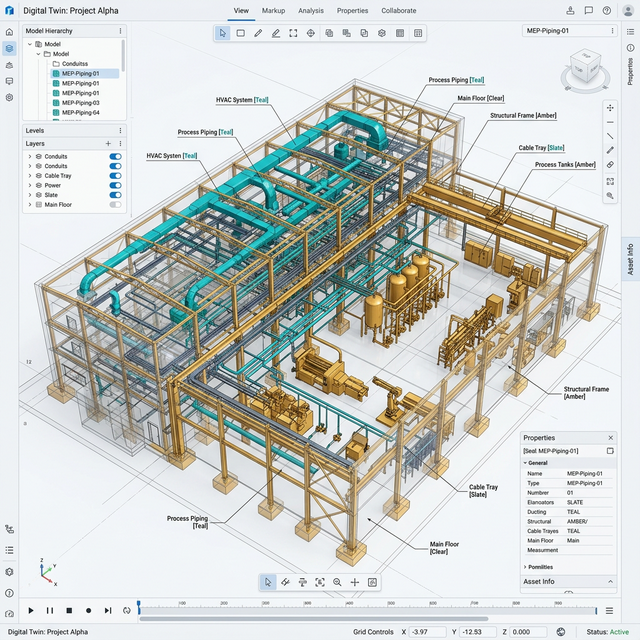
3. An Actual Digital Twin: You take the intelligent BIM model and you wire it up to reality. You feed live sensor data into it. The model knows what the current flow rate of that chilled water pipe is. It logs every time a maintenance crew replaced a valve. The model updates and evolves in real-time alongside the physical building. The key word here is live.
The LOD trap
If you are commissioning an existing-conditions model, you'll hear the term LOD (Level of Development). It ranges from LOD 100 (basic blocky shapes) to LOD 500 (fully realized, as-built verified systems).
Most infrastructure clients who want a "digital twin" of an old factory or a heritage building actually just need a highly accurate LOD 400 BIM model built from a laser scan. They want to know exactly where the load-bearing columns are so they don't hit them during a retrofit. They don't necessarily need live IoT sensor data feeding into a dashboard.
Don't buy a digital twin if all you need is an accurate map.
When does a true twin make financial sense?
Building and maintaining a live digital twin is expensive. It requires serious server infrastructure, dedicated platform management, and rigorous data discipline.
It makes financial sense when you are managing an asset where operational downtime costs a fortune. If you run a massive industrial plant, an airport terminal, or a regional water network, having a live twin allows you to simulate a shutdown before you touch a wrench. It allows remote engineering teams in another country to walk through the plant in Virtual Reality to troubleshoot a failing pump.
If you are just throwing up a standard commercial warehouse, the ROI on a live digital twin is entirely negligible. Get a good BIM model for construction, hand over the PDFs, and move on.
The Geopage reality
When we build these models for clients, we always start with the laser scan. You cannot build a digital twin of an existing facility based on old paper drawings—the drawings are always wrong. We capture the absolute physical reality, model it in Revit, and then help the client figure out exactly which data streams actually need to be tied into the 3D geometry to solve their specific operational headaches.